- Client
- Lumtri — in-house product
- Type
- Consumer marketplace
- Market
- Aklan, Philippines
- Status
- Open beta, 2026
- Product strategy
- UX & interface design
- Full-stack engineering
- Trust & safety systems
- Infrastructure & deployment
- Ongoing operation
- Next.js
- TypeScript
- PostgreSQL
- Supabase
- Tailwind CSS
- Vercel
The problem
In Aklan, second-hand trade already works. It happens in community group chats, in comment threads forty replies deep, and in messages that begin with the words "still available?". The market is real and it is busy.
What is missing is not demand. It is structure. There is no search, so the same item is posted six times. There is no history, so a seller who took someone's money last month is indistinguishable from one who did not. And renting — which in a province with seasonal tourism and agriculture is enormous — has nowhere to live at all, because a chat thread cannot express a date range.
The existing national platforms do not fix this. They are built for Manila-scale liquidity and treat a province as a filter, which means a listing three hours away outranks the one two barangays over.
The decision that shaped everything
We could have built a faster classifieds board. Instead we built the site around one question: can I trust the person on the other end?
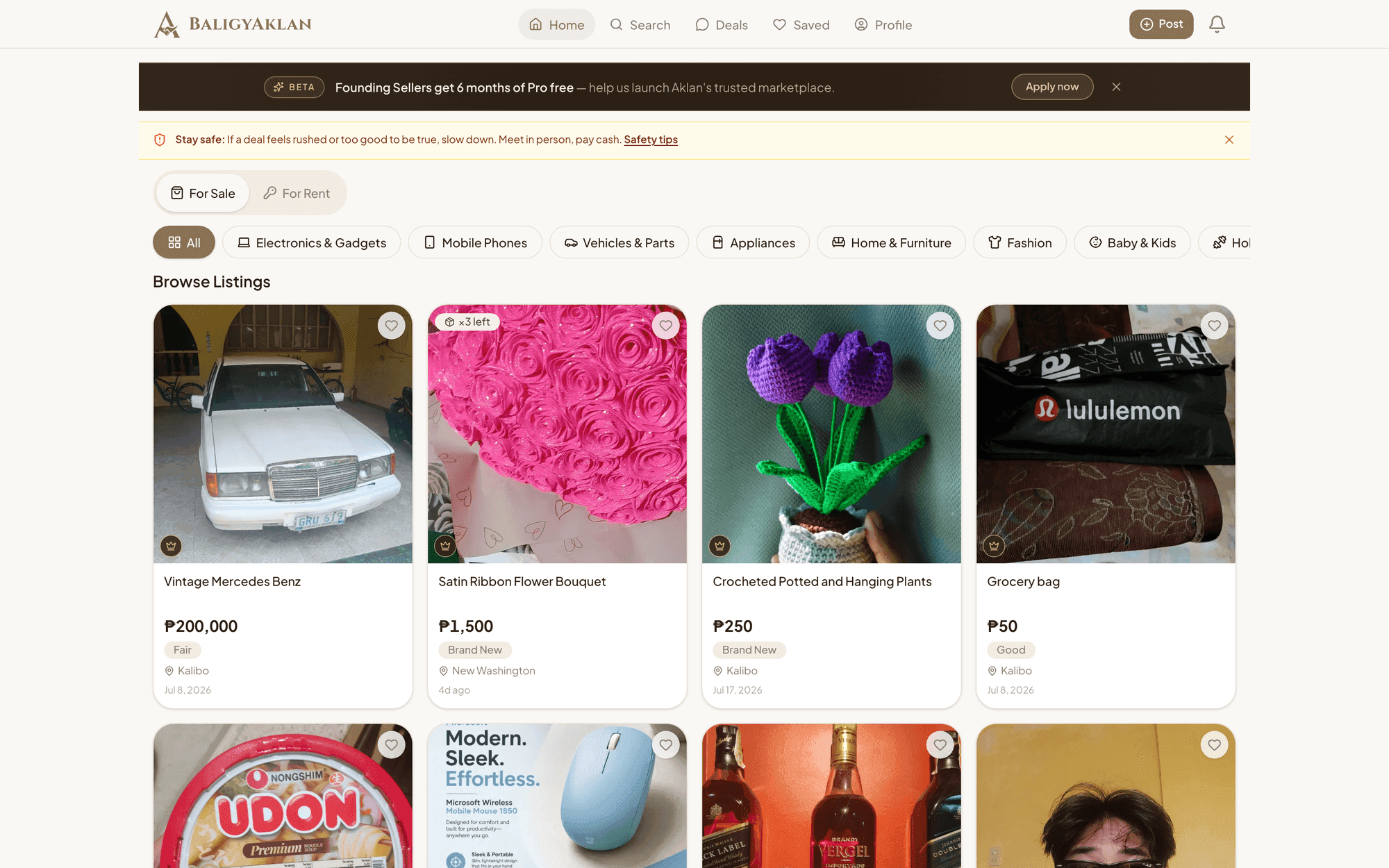
That single choice shows up everywhere in the interface. Safety guidance is not a link buried in the footer — it sits across the top of the browse page, in plain language, telling people to slow down when a deal feels rushed and to meet in person. It is there because the only moment anyone reads a safety notice is the moment before they act.
It also determined what we refused to build. No instant cash-out before there is a dispute process behind it. Shipping a trust feature you cannot yet enforce is worse than not shipping it, because it converts a sensible caution into a false promise.
Renting as a first-class listing type
Most marketplace software treats rent as a checkbox on a sale. It is not. A rental has availability, a return date, a deposit, and a condition assessed at both ends — none of which a sale has.
So For Sale and For Rent are a top-level switch on BaligyAklan, not a filter buried in a category tree. In a province with seasonal tourism and agriculture, renting equipment, venues, and vehicles is not a minor mode — for a lot of people it is the entire reason to open the app.
Modelling that properly at the schema level before launch is the kind of decision that costs nothing in week two and an enormous amount in month eight.
Built to survive its own success
Every listing carries the things that decide a transaction and nothing that does not: price in pesos, condition, the municipality it is in, and how recently it was posted. Kalibo and New Washington are meaningful to a buyer in Aklan in a way that "Western Visayas" never is.
Underneath, the beta is already running a Pro tier and a Founding Sellers programme — because a marketplace that has not worked out how it earns money is not a product, it is a hobby with a hosting bill.
Why this project is on this website
BaligyAklan is not a portfolio piece. It is a product we own, operate, and are on call for — the same stack, the same standards, and the same monitoring we bring to client work.
That is the point. When a business hires a young studio, the risk they are pricing in is whether we can survive contact with production: real users, real money, real edge cases at eleven at night. We would rather answer that with something you can open in a browser than with a case study about someone else's logo.
- Built by
- Three people
- Listing types
- Sale & Rent
- Stage
- Open beta
- Operated by
- Lumtri